99%+ purity
A2LA-accredited US lab
Certificate with every batch
2–4 day US delivery
Please note
This page is an editorial and informational resource about certificates of
analysis: what the document certifies, which analytical methods sit behind each line, how
results are expressed, and what accreditation of the issuing laboratory means. It is written
for professional and trade readers who evaluate supplier documentation as part of their work.
Nothing is sold on this page. It is a published editorial resource, not a
shop and not a testing laboratory. Nothing here is an offer, and no order can be placed
through this site. Certificates discussed on this page are issued by independent
laboratories, and the descriptions are general explanations of common analytical practice,
not a substitute for reading the specific report attached to a specific lot.
Nothing on this page is guidance on the selection, handling or end use of any material, and
no claim of any kind is made or implied about what any material does. This resource is
written for readers aged 21 and over.
In this guide
What You Will Find on This Page
What a COA is
The document itself: what it certifies, what it deliberately does not, and who signs it.
The methods
Chromatography, mass spectrometry, titration: which test answers which question.
Reading the result
Specification versus result, area percent, and why the lot number is the important field.
Red flags
Nine things that separate a working report from a decorative one, and what to ask for instead.
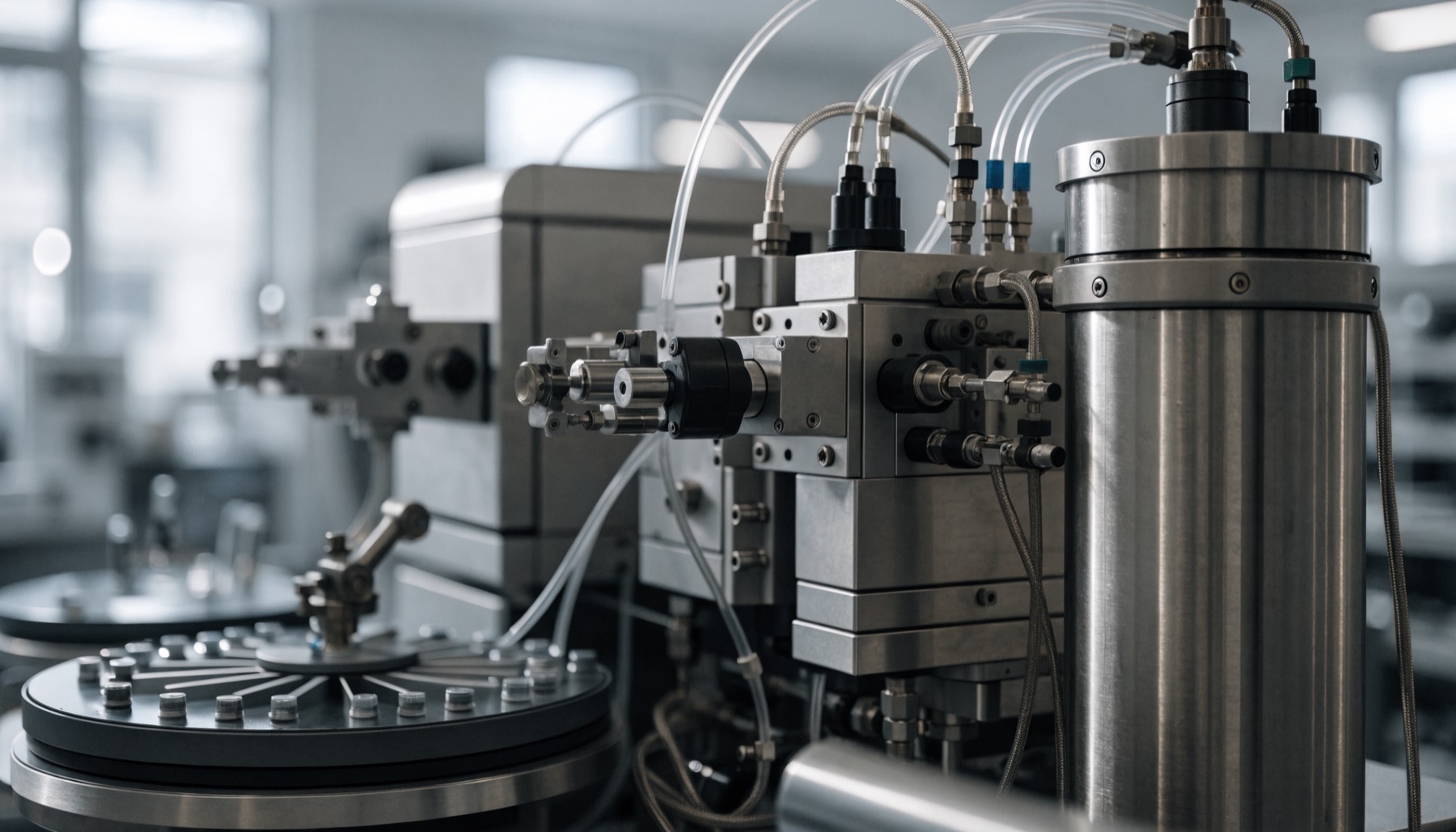
Separation first, measurement second. Almost every purity figure on a certificate of analysis begins on an instrument like this one.
Buyer's guideResearch Guild Labs editorial31 July 202610 min read
How a Certificate of Analysis Works, and How to Read One
Every serious supplier will tell you their material is tested. Far fewer will hand you the
document that proves it, and fewer still will hand you the document that matches the exact
lot in the box. That document is the certificate of analysis, usually
shortened to COA, and learning to read one takes about ten minutes. After that you can tell
a working report from a decorative one at a glance.
This guide covers what a COA actually certifies, which analytical method sits behind each
line on it, how results are expressed and why the phrasing matters, what accreditation of the
issuing laboratory does and does not guarantee, and the specific red flags worth walking away
from.
What a certificate of analysis actually is
A COA is a testing record for one specific batch. Not for a product line, not
for a supplier, not for a category, but for one production lot, identified by a lot or batch
number, tested on a stated date, by a named laboratory, using stated methods.
That scope is the whole point, and it is where most misreadings begin. A COA is not a quality
badge a company earns once and displays forever. It is a snapshot: this material, this
lot, these tests, this date, these results. A supplier with an excellent COA on lot A has
told you nothing at all about lot B. The useful question is therefore never "do you have a
COA?" but "may I see the COA for the lot I am being sent?"
A complete certificate carries, at minimum: the material identifier, the lot or batch number,
the date of manufacture and the date of analysis, each test performed, the method used for
each test, the specification (the acceptance range), the result obtained, a pass or fail
judgement per line, and the name and authorisation of whoever released it. Anything missing
from that list is a question to ask, not a detail to skip past.
Who issues it, and what accreditation means
COAs come from one of two places: the manufacturer's own quality control laboratory, or an
independent third-party laboratory. Both are legitimate, and they answer slightly different
questions. An in-house COA tells you the producer's own QC found the batch within
specification. A third-party COA tells you someone with no commercial interest in the result
found the same thing. Where the two disagree, the independent report is the more informative
one.
The credential worth looking for on the letterhead is ISO/IEC 17025, the
international standard for the competence of testing and calibration laboratories. It is a
meaningful accreditation: it covers method validation, equipment calibration and traceability,
analyst competence, sample handling, and what the laboratory must do when a result falls
outside specification.
Two caveats, because this is the credential most often oversold. First, it is
scoped: a laboratory is accredited for particular methods on particular sample
types, not for everything it can physically run, and that scope is published. Second, an
accredited laboratory reports on the sample it received. If the sample was
not representative of the lot, or was not drawn under a controlled procedure, the
laboratory's accreditation does not repair that. Accreditation raises confidence in the
measurement, not in the sampling.
Inside the document: the tests and what each one proves
Different lines on a COA answer genuinely different questions, and it is worth knowing which
is which, because a report can look thorough while quietly omitting the one test that
matters for your purpose.
Test
The question it answers
Typical method
Identity
Is this material the one named on the label?
Mass spectrometry (LC-MS), sometimes with NMR or FT-IR
Purity
What proportion is the named material rather than related substances?
Reversed-phase HPLC with UV detection
Water content
How much residual moisture does the material carry?
Karl Fischer titration, or loss on drying
Residual solvents
Is anything left over from processing or purification?
Headspace gas chromatography (GC)
Heavy metals
Are trace metallic contaminants within limits?
ICP-MS
Appearance
Does the physical form match the written specification?
Visual inspection against a described standard
Not every material warrants every row. What matters is that the tests present are the ones
that make sense for the material, and that each result has a method stated beside it.
Identity and purity are not the same claim
This is the single most common confusion. Identity asks whether the material
is what it says it is. Purity asks how much of the sample is that material
rather than something else. A sample can pass identity and still be badly impure; it can also
be extremely pure and be the wrong material entirely. A certificate that reports one without
the other is answering half the question, and a high purity figure with no identity test
anywhere on the page deserves real suspicion.
Reading a chromatogram without being a chemist
Read the report at full size, line by line. The useful information sits in the columns most people skip.
Most purity figures come from high-performance liquid chromatography. The principle states in
one sentence: the sample is pushed through a column that makes different components travel at
different speeds, and a detector at the far end records what comes out and when. The output is
a chromatogram: a baseline with peaks rising from it. Each peak is something that came off
the column at a particular time.
The purity figure is normally an area percent: the area under the main peak
divided by the total area under all peaks, as a percentage. So "99.1% by HPLC" means the main
peak accounts for 99.1% of the total detected response, at the detection wavelength
used.
That qualifier does real work, and it is why the method column matters. A UV detector only
sees what absorbs at the wavelength it is set to. Anything that does not absorb there
contributes no peak, and therefore no area. Water and residual salts, for instance, are
largely invisible to it. This is not a trick; it is a well-understood property of the method,
and it is exactly why a serious COA reports water content separately by titration rather than
leaving you to assume the HPLC figure covered it.
Four things to check on any chromatogram
Is the baseline flat and quiet? A drifting or noisy baseline makes every integration sitting on top of it less reliable.
Is the main peak symmetrical? Heavy tailing or a shoulder can hide a co-eluting component inside what is being counted as one peak.
Are secondary peaks shown, or cropped away? A chromatogram trimmed to the main peak is not evidence, it is a picture.
Does the retention time match the reference? Identity by retention time alone is weak evidence, but a mismatch is a genuine flag.
Specification versus result
A well-built COA puts two columns side by side: the specification, meaning
the range the material was required to fall inside, and the result, meaning
what the instrument actually measured. Reading only the result is how buyers end up satisfied
with a number that never had a target to miss.
A specification of "≥ 98.0%" against a result of "99.3%" is a clean pass with headroom. The
same specification against a result of "98.1%" is also a pass, but it is a pass at the edge,
and when you are comparing two suppliers that gap tells you something the pass/fail column
does not. Where results appear with no specification beside them, there is nothing to pass or
fail against, and the document has quietly become a list of numbers.
One more piece of phrasing worth knowing: results are sometimes reported as "not
detected" rather than zero. Those are different statements. "Not detected" means
below the method's limit of detection, and a rigorous report states what that limit was. Zero
is a claim no instrument can actually make.
The lot number is the field that matters
Documentation is only traceable if the identifier on the container also appears on the report, and on the retained sample.
Everything above is worth nothing if the certificate in front of you describes a different
batch from the material in front of you. Traceability is the whole mechanism, and it rests on
one unglamorous field: the lot or batch number, printed on the container, repeated on the
certificate, and recorded against the sample the laboratory retained.
A supplier running this properly can do three things on request. Provide the certificate for
the specific lot you received, rather than a representative example. Show that the identifier
on the label matches the identifier on the report. And state how long a retained sample of
that lot is held, so an independent re-test stays possible if a result is ever disputed.
The strongest version of this is per-lot documentation the buyer can pull themselves: a
reference on the label that resolves to that lot's own report, rather than a PDF emailed on
request. It removes the step where a document has to be selected by hand, which is precisely
the step where the wrong one gets sent.
Nine red flags
No lot or batch number. Without it the document cannot be tied to anything, and everything else on it is decoration.
No laboratory named. "Third-party tested" with no third party named is not a claim anyone can check.
No methods stated. A result without a method cannot be interpreted, compared or reproduced.
Results with no specification column. Nothing to pass or fail against.
A flat image with no data behind it. A low-resolution picture of a chromatogram, cropped to the main peak, tells you only that a chromatogram exists somewhere.
Dates that do not work. An analysis date before the manufacturing date, or a certificate years older than the stock, means the document has been reused.
Identical documents across different lots. Real measurements vary slightly. Two lots with byte-identical results are one lot's report, copied.
Unsigned or unauthorised. Someone has to release a batch. If nobody is named, nobody is accountable.
A purity figure with no identity test. High purity of an unconfirmed material is not a reassuring statement.
None of these require a laboratory to spot. They are all visible on the face of the document
in under a minute, which is what makes them useful.
A checklist before you accept a batch
Ask for the COA for the lot being shipped, not a sample certificate.
Check the lot number on the certificate against the one on the container.
Confirm the issuing laboratory is named, and check whether it is accredited and for what scope.
Read the method column. Every result should have one beside it.
Compare each result against its specification, and note anything sitting at the edge.
Look for identity and purity, not one standing in for the other.
Check that water content and residual solvents are reported separately where they are relevant.
Look at the full chromatogram, secondary peaks included.
Check the manufacturing and analysis dates against each other, and against the age of the stock.
Ask how long retained samples are held, and keep your own copy of the certificate on file.
Ten checks, most of them a few seconds each. The habit is worth building, because the pattern
is consistent: suppliers who publish complete documentation tend to have the systems that
produce complete documentation, and suppliers who publish a number tend to have the number.
About this resource
More About Research Guild Labs
Who publishes this resource, why it exists, and how to reach the editor with a correction or a question about the guide.
This editorial resource on analytical testing documentation is published by Research Guild Labs, based in Sheridan, Wyoming. It exists because the questions a buyer should ask
about a certificate of analysis are almost always the same ones: what was tested, by whom,
using which method, and against which specification. They are easier to answer once,
properly and in public, than one conversation at a time.